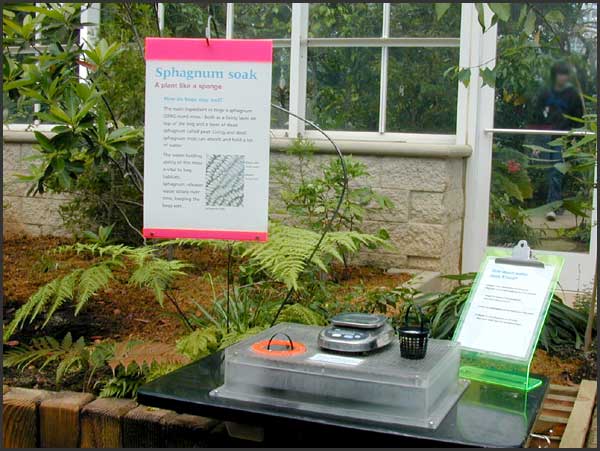
Comparison of the weight of dry and moist sphagnum moss. |
| Classification |
Sphagnum moss is also called peat moss. It is a bryophyte
with great economic importance. It has 160 species and is in the only genus in the subclass Sphagnidae. |
| Stem structure |
branches cluster together as fasicles around main stem. Dimophic branches:
Spreading branches: give plant structure.
Hanging branches: help to draw water.
Young branches are packed into a capitulum (head) near the apex of the plant.
|
Leaf structure
|
The most distinctive feature of sphagnum moss is its unique arrangement of two different kinds of cells in its leaves:
Green cells: small, living cells with chlorophll for photosynthesis.
Hyaline cells: large, dead, structural cells with large pores. These cells make sphagnum moss very porous and
are responsible for its water-holding ability. |
| Reproduction |
asexual reproduction by fragmentation.
sexual reproduction by heteromorphic alternation of generation. |
| Usage |
many different usages: peat moss can be dried and used as fuel, as a packing material, as a seed bed cover, and as a soil additive;
earlier usages included surgical dressings, diapers, etc. |
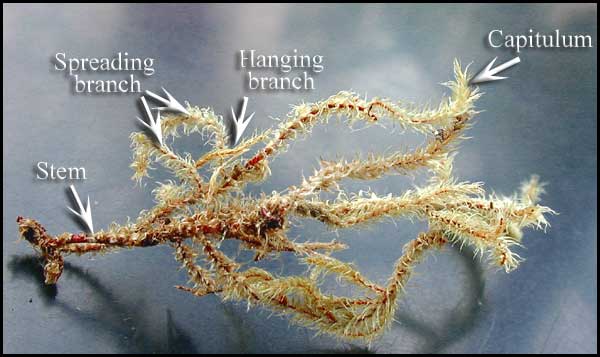
An individual peat moss |