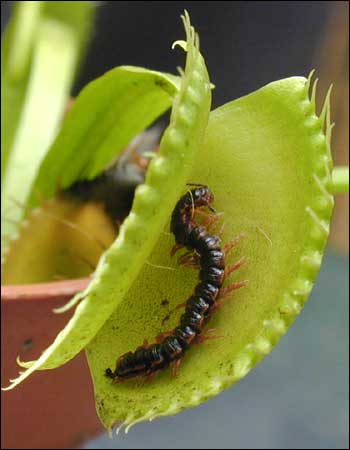
Trapping system:A Venus flytrap leaf has two regions: a long heart-shaped
petiole
that is capable of photosynthesis; and a two-lobed trap-like leaf blade. The leaf blade is
covered with mesh-like cilia. |
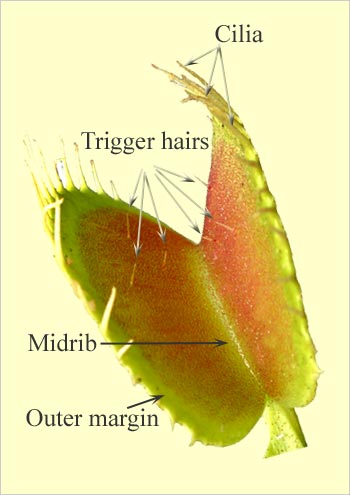
A two-lobes Venus flytrap leaf blade |
| Cilia: (guard hairs). Prevent big prey from escaping, and let small prey escape to conserve energy. |
| Trigger hairs: There are usually three trigger hairs on each lobe, forming a triangle with the apex pointing toward midrib.
To trigger a flytrap, one can either touch a trigger hair twice, or touch two trigger hairs within 20 seconds. There are many other factors (such as the plant's health,
age, ambient temperature, and how long since the last closure etc.) that also influence the triggering of a flytrap. |
There are two structurally identical sessile glands on the lobes: |
| Alluring glands: colorless, located at the outer margin of the lobes.
They produce sweet nectar to lure prey. |
| Digestive glands: the reddish regions of the lobes. The red color comes from the anthocyanin pigments
and works as another attraction beside the nectar. They secret enzymes to digest the prey and absorb its nutrients. Venus flytraps do not need bacteria
for digestion. |
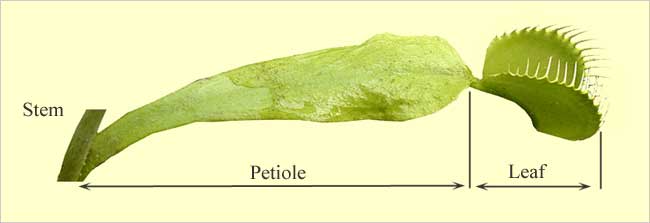
A Venus flytrap leaf |