| Flowers are made up of four basic parts
(floral series): the calyx, corolla, androecium, and gynoecium.
The androecium and gynoecium are the two fertile floral series (andro: "male", gyno: "female", ecium: "home").
The calyx and corolla, collectively called the perianth, are not directly involved in
sexual reproduction. All four floral series are derived from highly specialized leaves. |
Two sterile floral series (Perianth): |
|
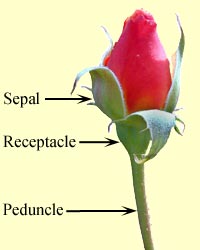
collective term for sepals, the outermost part of a flower that protects the flower bud until it blooms. |
| |
collective term for petals, whose main function is to attract pollinators: usually brightly colored. |
|
Sepals are usually green, leaflike and relatively rough.
 |
In some flowers, sepals and petals can look similar.
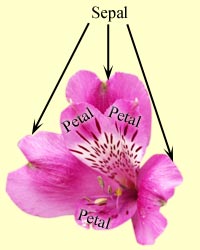 |
When sepals and petals are similar in size, shape and color,
they are called tepals.
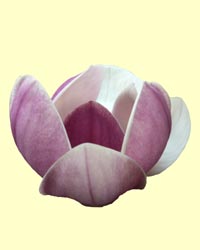 |
Two fertile floral series: |
| Androecium |
collective term for stamens, each of which includes a filament and anther.
It is the male part of a flower that produces pollen. |
| Gynoecium |
collective term for pistils (carpels), each of which includes a stigma, style and
ovary. It is the female part of a flower that produces eggs (ovules). Ovules can develop into seeds.
Fruits develop from the mature ovary. |
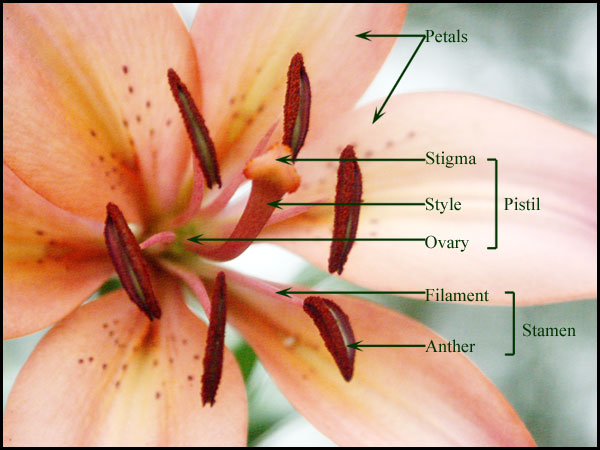 |
|
|
a pistil formed by a single carpel. |
|
|
a pistil formed by fusing two or more carpels. |
Other terms: |
Peduncle |
the stem that supports a solitary flower or an inflorescence. |
Pedicel |
the stalklike stem that supports an individual flower in an inflorescence. |
| |
the enlarged end of a flower-bearing stem where the various flower parts attach. |