Huntington>Conservatory>Plant Lab >Seed-bearing Vascular Plants

Seed-bearing vascular plants

Seed-bearing vascular plants are more specialized to life on land than seedless vascular plants such as horsetails and ferns. The male gametophytes are reduced to pollen grains, so free water is no longer needed to allow the sperm to swim to the eggs. Wind and animal vectors are used instead to transfer the sperms to the eggs. The eggs of these plants are enclosed in protective integument layers. The seeds of angiosperms are further protected by their fruits, which are formed from the ovary walls. Gymnosperms do not have fruit, so their seeds are "naked" ("gymno" means naked in Greek).
There are four divisions of gymnosperms:   Cycadophyta,   Ginkgophyta,   Gnetophyta and   Coniferophyta.
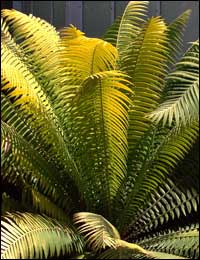
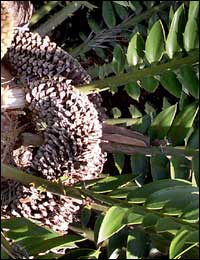
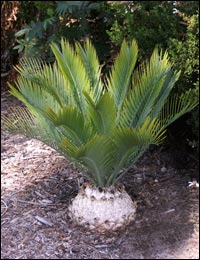
Cycadophta (cycads): Cycads are gymnosperms that once were the dominant form of vegetation in the age of the dinosaurs. These ancient plants are usually found in tropical and subtropical area. Most cycads resemble tree ferns or palm trees in appearances. They are often mistaken for palms , which are angiosperms. Cycads are usually pollinated by wind or insects (beetles).    More cycads

Fern- or palm-like leaves.

All cycads are dioecious: there are male and female cycads.

Cycads are evergreen.
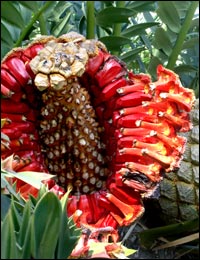
Usually produce one crown of leaves per year Pollen cone: contains fagellated sperm; the largest sperm cells among plants Seed cone of
Encephalartos arenarius
Encephalartos princeps

Back to the top

Ginkgophyta: The only species in this division is Ginkgo biloba. Also called Maidenhair tree, Yin Xing ("Silver-aprocot") in Chinese.     Learn more about Ginkgos

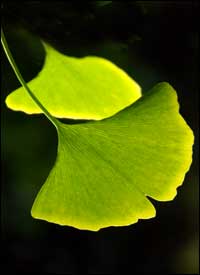
Ginkgos have unique leaves:

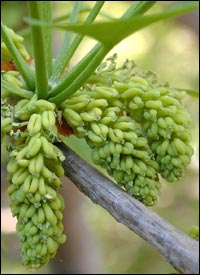
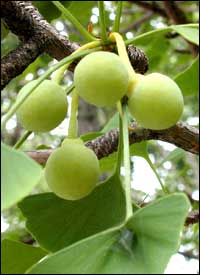
Ginkgos are dioecious: there are male and female ginkgo trees.

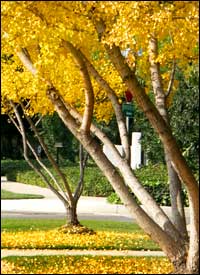
Gingkos are deciduous:
Dichotomous venation Male with pollen cones:
contain flagellated sperm
Female with immature ovules:
not berries (no ovary wall)
Leaves turn gold and fall off in autumn.

Back to the top

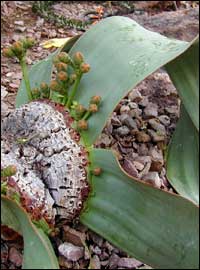
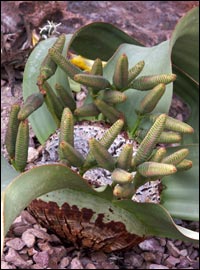
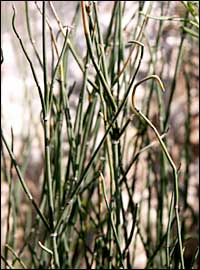
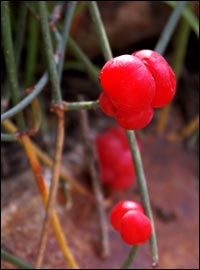
Gnetophyta: This division includes three very distinctive-looking genera: Gnetum, Ephedra and Welwitschia. Ephedra (Mormon tea, ma huang) is the largest and most common. Gnetophytes are the only gymnosperms that undergo double fertiliztion like angiosperms, forming two zygotes in each seed. However, one of the zygotes does not mature.
Welwitschia Ephedra
Woody stems and strap-like leaves Dioecious Small leaves Photosynthetic green stems

Back to the top

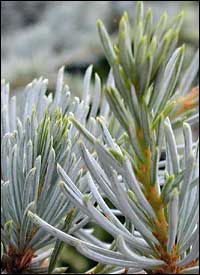
Coniferophyta: All conifers are wind-pollinated. Pinus (pines) are the most abundant conifers in the Northern hemisphere.
Needlelike leaves Most are monoecious, some are dioecious Mostly evergreen trees
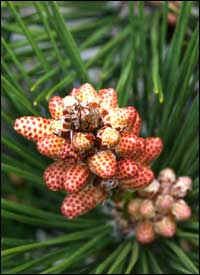
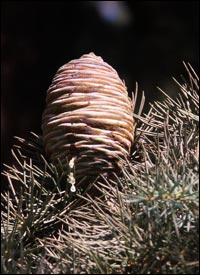
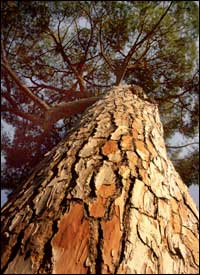
Leaves group into fascicles Male cone contains microspores Female seed cone Huge trunk of a pine

Back to the top


Back to Plant Lab mainpage

Back to Conservatory


Copyright for the photos on this website belongs to Pu Chen. Images should not be redistributed without the permission of the photographer.