Spanish moss
Tillandsia usneoides (usneoides="moss-like"; from usnea="beard lichen"), family Bromeliaceae
Other common names: Grey Beard , Florida moss, Long moss, Pele's hair (Hawaiian) |
| Classification |
Spanish moss is not a moss but a pineapple-related
flowering plant. It is a perennial
monocot in the bromeliad family. |
| Not a parasite |
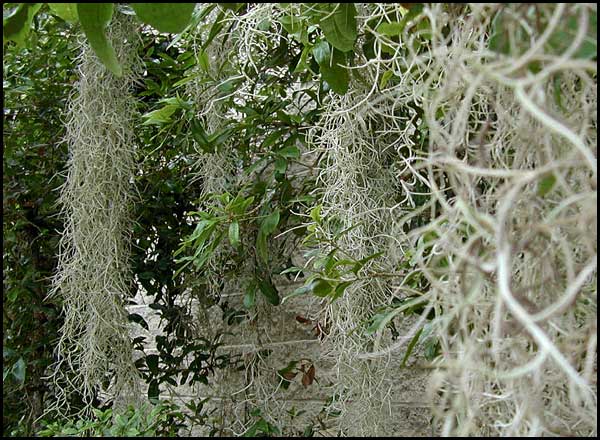
Spanish moss wraps around tree branches but only uses them for mechanical support.
It does not take nutrients from the host tree like a parasite (e.g. mistletoe) would. |
| A rootless epiphyte |
Spanish moss has no roots. It gets its moisture and nutrients from air and rainfall.
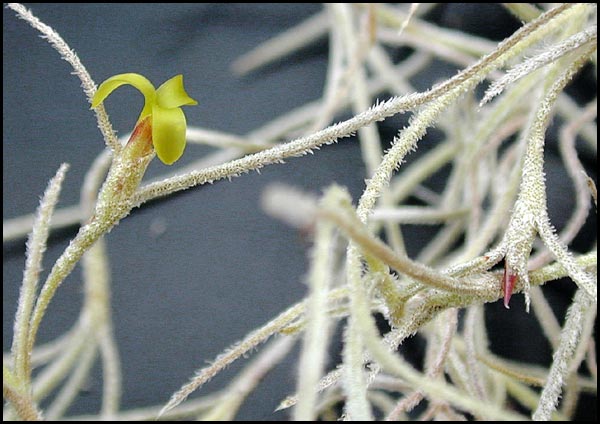
There are scales (trichomes) on its leaves and stems
which help it to capture and conserve water and nutrients from the air. |
| Reproduction |
Mainly propagates by vegetative reproduction through fragmentation.
Also reproduces by seeds.
After flowering, a seed capsule will develop for six month before it releases tiny seeds
that are dispersed either by wind or by birds. |
| Distribution |
Spanish moss likes warmth and humidity, it is distributed from southeastern US to Argentina. |
| Usage |
Many different uses: as packing material, in handicrafts, as mulch,
and widely used in the floral industry. |